
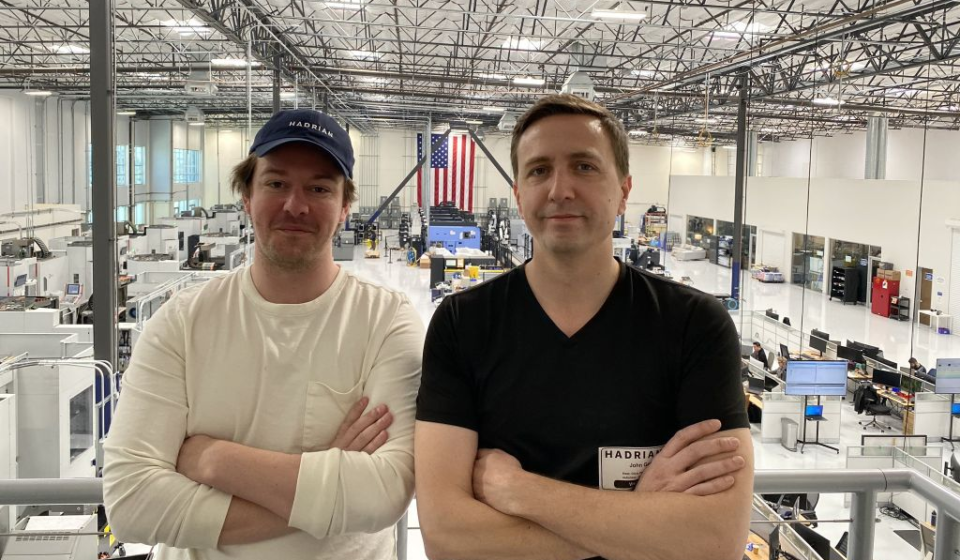

Defense manufacturing startup Hadrian has raised $1.37 billion in a new funding round, pushing the company’s valuation to nearly $8 billion and highlighting the growing appetite for technology aimed at rebuilding and modernising the US defense industrial base.
The Series D investment gives Hadrian significantly more financial firepower as it expands its network of highly automated factories and increases production of precision components used in aerospace and defense.
The company was valued at approximately $7.87 billion following the latest financing, making the new valuation almost five times higher than its previous level.
Building factories for a new defense era
Founded by Chris Power, Hadrian has built its business around a relatively straightforward problem: producing sophisticated physical components for defense and aerospace companies can be slow, expensive and dependent on fragmented supply chains.
The company is attempting to change that by operating factories that combine advanced manufacturing equipment, software, automation and artificial intelligence.
Rather than focusing solely on developing new weapons or military systems, Hadrian is targeting the industrial infrastructure needed to manufacture them.
Its software platform, known as Opus, is designed to coordinate manufacturing processes and help factories operate with greater efficiency.
Defense demand fuels expansion
The company’s rapid fundraising comes as governments and defense contractors face increasing pressure to expand production capacity.
Conflicts and geopolitical tensions have exposed weaknesses in defense supply chains and increased demand for ammunition, aircraft components, missile systems, drones and other military equipment.
That environment has created an opportunity for companies that can increase manufacturing capacity without relying entirely on traditional production methods.
Hadrian already works with major defense and aerospace companies, including large contractors and newer defense technology firms. Its customer base has helped demonstrate demand for the company’s manufacturing model.
AI meets industrial production
Hadrian’s strategy reflects a broader shift in the technology industry.
While many AI startups are focused on software, chatbots and digital services, a growing group of companies is applying artificial intelligence to physical industries such as manufacturing, robotics and defense.
For Hadrian, AI is part of a larger automated production system. The goal is to use software to coordinate machines, workers, production schedules and quality-control processes, allowing factories to manufacture complex parts more quickly.
The company is effectively betting that manufacturing can become more responsive and software-driven.
Investors place a huge bet on reindustrialisation
The size of Hadrian’s latest funding round reflects growing investor confidence in the idea that the US needs to rebuild domestic manufacturing capacity.
The company raised $260 million in its previous Series C round only a little over a year ago. The jump to a $1.37 billion financing shows how quickly investor interest has increased.
The latest round was led by major institutional investors, alongside a long list of other backers.
For investors, Hadrian represents a combination of several powerful trends: artificial intelligence, automation, defense spending and the push to bring critical manufacturing capabilities closer to home.
A different kind of defense technology company
Hadrian’s business model also distinguishes it from many of the high-profile defense startups that have emerged in recent years.
Instead of developing autonomous weapons, drones or battlefield software as its primary product, Hadrian is building the manufacturing infrastructure that can support companies producing those systems.
That could make the company an important part of a larger defense technology ecosystem.
As military technology evolves rapidly, the ability to manufacture equipment at scale may become just as important as designing new systems.
Expansion comes with challenges
The enormous new valuation also raises expectations.
Hadrian will need to prove that its automated factory model can expand efficiently while maintaining the extremely high quality and reliability standards required by aerospace and defense customers.
Manufacturing physical components is fundamentally different from scaling software. Factories require equipment, materials, skilled workers, energy and significant capital.
The company therefore faces the challenge of turning its technology-driven approach into a profitable and repeatable industrial operation.
The bigger bet on American manufacturing
Hadrian’s funding round is more than another large startup investment. It reflects a broader belief among investors that defense manufacturing is entering a new phase.
The combination of geopolitical uncertainty, increased defense spending and advances in AI and automation is encouraging investors to put large amounts of capital into companies rebuilding the physical infrastructure behind national security.
Hadrian now has the resources to pursue that opportunity at a much larger scale.
Its success could ultimately depend on whether it can deliver on one ambitious promise: making defense manufacturing faster, more automated and capable of keeping pace with the rapidly changing demands of modern warfare.