
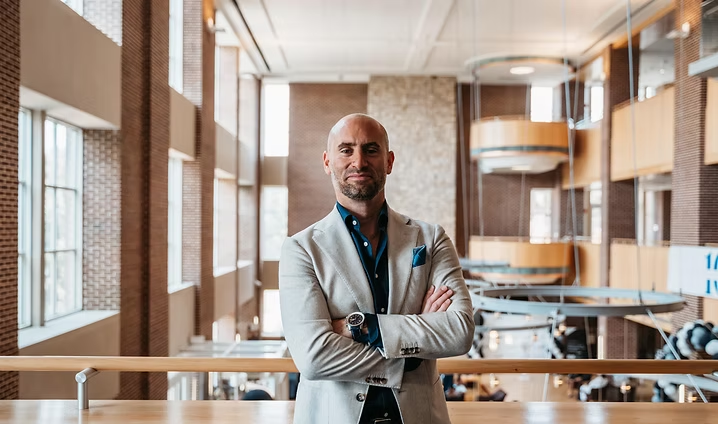

Entrepreneur and startup mentor Charlie Lass is advocating for a different approach to building successful companies—one that places founder well-being alongside growth, strategy and financial performance.
With experience launching products across multiple industries and working with hundreds of startups, Lass has built his career around helping entrepreneurs turn ideas into businesses while confronting the often-overlooked pressures that come with entrepreneurship.
His message is increasingly focused on a simple principle: building a company should not require sacrificing the person running it.
From startup growth to founder resilience
Lass has spent years working with entrepreneurs on areas including strategy, fundraising, branding, product launches and business growth. Through his consultancy work, he has sought to help founders test ideas quickly and avoid some of the costly mistakes associated with early-stage businesses.
His own experiences have shaped that approach.
Lass has spoken openly about the personal difficulties that can accompany entrepreneurship, including periods of intense stress and burnout. Rather than presenting startup life as a straightforward path from an idea to an eventual exit, he argues that founders should acknowledge the uncertainty, financial pressure and emotional challenges involved.
That perspective has become a central part of his work.
Challenging the traditional startup narrative
The startup world often celebrates rapid growth, large funding rounds and successful exits. Lass believes that this emphasis can create an incomplete picture of entrepreneurship.
Behind the headlines, founders may be dealing with long working hours, difficult financial decisions, strained relationships and constant uncertainty.
His approach encourages entrepreneurs to measure success more broadly. Business performance remains important, but so are sustainable working practices, healthy leadership and the ability to make good decisions under pressure.
For Lass, founder well-being is not separate from business performance. It is closely connected to it.
Making startup knowledge more accessible
Lass has also worked to make practical entrepreneurial knowledge available to a wider audience.
His Humble platform was created around the idea that founders should have easier access to useful information and lessons from people who have experienced the realities of building companies. The platform combines educational material with an emphasis on reducing the noise and pressure surrounding entrepreneurship.
The concept reflects Lass’s broader belief that founders should not have to navigate every challenge alone.
Instead of relying exclusively on traditional startup networks, entrepreneurs can learn from the experiences of other business builders and gain practical guidance on subjects ranging from market testing and fundraising to leadership and personal resilience.
Learning from failure
Another important part of Lass’s philosophy is his willingness to discuss failure.
Rather than treating unsuccessful ideas as something that should be hidden, he argues that mistakes can provide some of the most valuable lessons for entrepreneurs.
This approach challenges the image of the founder who always knows what to do. In reality, startups frequently require people to make decisions with incomplete information and adjust when their assumptions prove wrong.
Lass encourages founders to treat those setbacks as opportunities to learn rather than as evidence that they are incapable of succeeding.
The mental cost of entrepreneurship
Founder mental health has become a growing topic across the startup ecosystem, particularly as entrepreneurs face increasing pressure to grow quickly and compete for limited investment.
Lass has positioned himself as an advocate for greater openness about those challenges. His work highlights the importance of recognising stress before it becomes overwhelming and creating systems that allow founders to maintain perspective.
That can include clearer priorities, realistic expectations, stronger boundaries and access to appropriate support.
The underlying message is that resilience should not mean simply enduring unlimited pressure. Instead, founders need to understand their limits and build companies in ways that allow them to remain effective over the long term.
A broader definition of startup success
Lass’s philosophy represents a growing shift in the entrepreneurial community toward sustainability rather than relentless expansion.
For many years, startup culture has celebrated the idea of working harder, moving faster and pursuing increasingly ambitious targets. But as more founders discuss burnout and the realities behind high-growth companies, there is increasing interest in a model that balances ambition with sustainability.
Lass argues that entrepreneurs can still pursue ambitious goals without treating exhaustion as a measure of commitment.
His work ultimately puts forward a broader definition of success: building a company that performs well while allowing its founder and team to remain healthy, focused and capable of continuing the journey.
For startup founders facing the pressures of turning an idea into a viable business, that message offers a different perspective—success is not simply about how quickly a company grows, but whether the people building it can grow alongside it.