
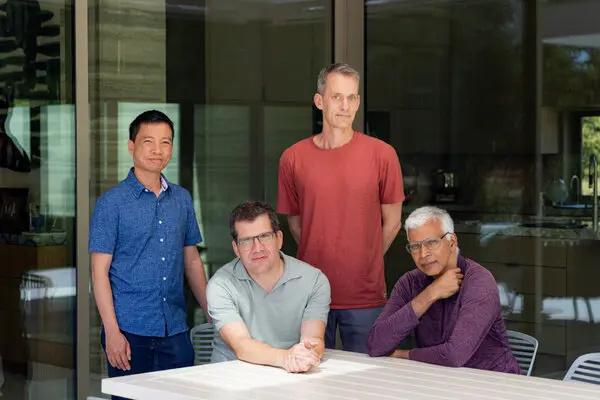

Four of Google’s most influential artificial intelligence researchers are leaving the technology giant to build a new company focused on using AI to accelerate scientific discovery.
The group includes Google chief scientist Jeff Dean, longtime Google researcher Sanjay Ghemawat, Google DeepMind research executive Oriol Vinyals and AI researcher Quoc Le. Together, they are launching Discovery Loop, a startup that aims to apply artificial intelligence to problems in science and engineering.
The departures represent a notable loss of senior technical talent for Google at a time when competition in advanced AI is intensifying.
Jeff Dean ends 27-year Google career
Dean’s departure is particularly significant. He joined Google in 1999 as one of the company’s earliest employees and went on to become one of its most important engineers and scientific leaders.
During his career, Dean helped develop technologies that became fundamental to Google’s computing infrastructure and played a major role in the company’s evolution into an AI powerhouse.
He later became head of Google’s AI division and, following the combination of Google Brain and DeepMind, served as Google’s chief scientist.
After nearly three decades at the company, Dean is now turning his attention to a new challenge outside Google’s corporate structure.
A team built around scientific discovery
Discovery Loop is being created with an ambitious goal: using AI to automate and accelerate parts of the scientific research process.
Rather than focusing primarily on consumer chatbots or general-purpose AI assistants, the startup intends to develop systems that can help researchers explore scientific and engineering problems.
Potential applications could include areas such as drug discovery, materials research and computer-chip design.
The broader idea is that AI systems could eventually perform more of the repetitive and computationally intensive work involved in scientific experimentation, allowing researchers to evaluate more possibilities in less time.
Deep experience in AI research
The four founders bring decades of experience in artificial intelligence and large-scale computing.
Ghemawat worked alongside Dean on some of Google’s foundational distributed-computing systems and has spent much of his career developing technologies capable of processing enormous quantities of information.
Vinyals has been a major figure in Google DeepMind’s research programme and has contributed to important developments in machine learning and AI systems.
Le was also an early contributor to Google’s AI research and has worked on neural networks, machine learning and large-scale AI applications.
Their combined experience gives Discovery Loop a team with unusually deep knowledge of both AI research and the infrastructure required to build advanced systems.
Why researchers are moving beyond Big Tech
The decision by four senior researchers to leave Google reflects a broader shift taking place across the AI industry.
Large technology companies continue to possess enormous computing resources, datasets and research budgets. However, independent startups can offer researchers greater freedom to pursue specific ideas without the organisational priorities of a major corporation.
The rapid growth in AI investment has also made it easier for experienced researchers to attract capital and assemble teams around ambitious scientific projects.
Discovery Loop is entering an environment where investors are increasingly interested in AI companies that can produce advances in fields beyond software.
Google remains connected to the new venture
Despite the departures, the relationship between Discovery Loop and Google is not simply one of competition.
Alphabet, Google’s parent company, is reportedly investing in the new startup. That arrangement could give Discovery Loop access to financial backing while allowing Google to maintain a connection with some of the researchers who helped shape its AI strategy.
It also reflects how the boundaries between technology giants and AI startups are becoming less straightforward.
Major companies can invest in emerging competitors, collaborate with former employees and maintain relationships with researchers even after they leave.
Leadership changes at Google
The departures come alongside a broader restructuring of Google’s AI leadership.
DeepMind chief Demis Hassabis is moving into a new role as chairman of Google DeepMind and chief scientist of Alphabet, while Google adjusts responsibilities across its AI organisation.
The changes come as Google continues to compete with companies developing increasingly capable AI systems.
The company has invested heavily in its Gemini family of models and in the infrastructure required to train and operate advanced AI systems.
Losing several highly experienced researchers at the same time therefore carries symbolic significance, even though Google remains one of the world’s largest AI research organisations.
A bet on AI-powered science
Discovery Loop’s ambitions point toward a potentially important next stage of artificial intelligence.
The first generation of generative AI transformed how people interact with software by producing text, images, code and other digital content. The next opportunity could be using AI to help discover new medicines, materials, technologies and scientific theories.
That transition will be considerably more difficult. Scientific research requires experimentation, physical testing and rigorous validation, meaning AI-generated ideas must eventually be tested against the real world.
But if AI can shorten the cycle between hypothesis, experiment and discovery, the economic and scientific impact could be substantial.
A new chapter for Google’s AI pioneers
For Google, the departure of Dean and his colleagues marks the end of an important chapter. For the researchers, it represents an opportunity to pursue a vision that may have been difficult to execute inside a technology giant.
Discovery Loop now faces the challenge of turning that vision into working products and demonstrating that AI can do more than assist researchers—it can fundamentally accelerate how new knowledge is created.
With four veteran AI researchers at its core and backing from a major technology company, the startup is already attracting attention.
Its success could provide an early indication of whether the next major AI breakthrough will come from improving digital assistants—or from teaching machines to become powerful partners in scientific discovery.