
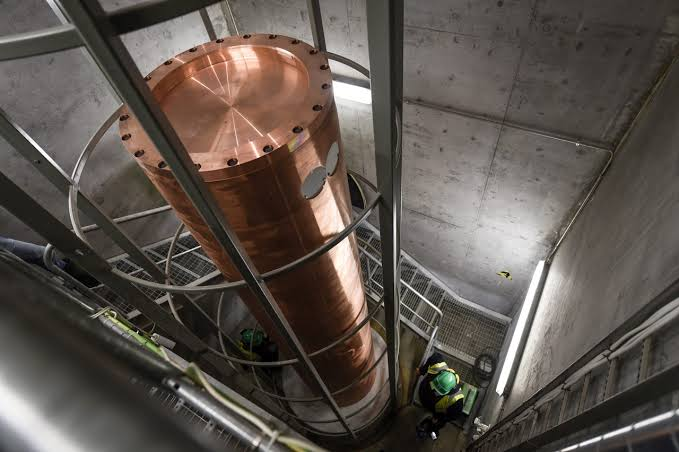

A partnership between nuclear startup Deep Isolation Nuclear and oilfield services giant Halliburton is testing an unconventional solution to one of the United States’ most persistent nuclear problems: how to safely store radioactive waste for extremely long periods.
The companies are adapting technology developed for the oil and gas industry to explore a new approach to underground nuclear waste disposal. At a demonstration site in central Texas, an oil-drilling rig is being used to test the concept of placing specially designed containers deep beneath the Earth’s surface.
The project comes as interest in nuclear energy is accelerating, driven in part by growing electricity demand from artificial intelligence and data centers.
Taking nuclear waste deeper underground
The concept behind the project is relatively straightforward. Instead of storing radioactive waste in a large underground mined repository, the partners want to place waste in deep geological formations using drilling technology.
The proposed system would take waste roughly two miles below the surface, where it could be isolated inside stable rock formations that have remained largely disconnected from the surface environment for extremely long periods.
Deep Isolation Nuclear says its approach could provide a new pathway for managing spent nuclear fuel and other radioactive materials while avoiding some of the challenges associated with conventional repositories.
The company is working with Halliburton because the oil industry has decades of experience drilling deep wells and steering equipment through underground formations.
Borrowing from the oil industry
Oil and gas companies routinely drill thousands of feet underground and use sophisticated equipment to control the direction of wells.
That expertise could be valuable for nuclear waste disposal.
Rather than drilling only vertically, the proposed system can use directional drilling to create pathways that extend through suitable geological formations. Special canisters would then be placed underground and isolated from the surface.
At the Texas demonstration facility, engineers are testing whether techniques developed for petroleum production can be adapted to the very different requirements of radioactive waste storage.
The partnership illustrates how technologies created for the fossil-fuel industry could find new applications as the energy sector changes.
A growing nuclear waste problem
The United States has spent decades searching for a permanent solution for its accumulated nuclear waste.
Commercial nuclear reactors have generated large quantities of spent fuel, but the country still lacks a permanent national repository for commercial spent nuclear fuel.
Instead, much of the material remains stored at or near nuclear power plants in specially designed facilities.
That situation could become more complicated if the United States enters a new period of nuclear expansion.
Advanced nuclear companies are developing reactors intended to provide reliable electricity for industrial facilities and data centers, while existing plants are also receiving renewed attention as electricity demand rises.
More nuclear generation ultimately means more nuclear material requiring long-term management.
The AI boom adds urgency
The growth of artificial intelligence has created enormous demand for electricity.
Large data centers require continuous power, and technology companies are increasingly examining nuclear energy as a potential source of reliable low-carbon electricity.
That has contributed to renewed investment in advanced reactors, nuclear fuel production and other parts of the nuclear supply chain.
But expanding nuclear power without addressing waste would leave a major part of the industry’s long-term challenge unresolved.
Supporters of deep-borehole disposal argue that solving the waste issue could help remove one obstacle to a broader nuclear renaissance.
Why deep geological disposal is attractive
The basic principle behind deep geological storage is to use natural barriers as part of a long-term containment system.
Thousands of feet of rock can provide significant separation between radioactive materials and the surface. The idea is not entirely new: geological isolation has been considered for decades as a way to protect future generations from hazardous nuclear material.
What makes the Texas project different is its attempt to combine that principle with modern directional drilling.
The approach could potentially allow engineers to select suitable underground formations and place waste containers along carefully controlled pathways.
Deep Isolation argues that this could provide greater flexibility than conventional mined repositories.
Significant challenges remain
The project is still a demonstration effort, and proving that the concept works in practice will require considerably more than successfully drilling a deep hole.
Engineers must establish that waste canisters can be manufactured, transported and installed safely. They must also demonstrate that underground formations will remain stable and that radioactive material can be isolated for the required timescales.
Regulatory approval is another major hurdle.
Nuclear waste disposal is subject to stringent safety requirements, and any commercial system would need to demonstrate long-term environmental protection before it could receive approval.
Public acceptance could prove equally important. Communities have historically been cautious about becoming hosts for nuclear waste facilities, even when scientists argue that carefully engineered geological storage can be safe.
An unusual energy partnership
The collaboration between a nuclear startup and one of the world’s best-known oilfield services companies highlights the increasingly blurred boundaries within the energy industry.
Oil and gas companies possess enormous expertise in drilling, subsurface mapping and managing complex underground operations. Nuclear companies, meanwhile, face the challenge of developing infrastructure capable of handling radioactive materials safely for generations.
Combining those capabilities could create new possibilities.
For Halliburton, the project represents a potential application of drilling expertise beyond traditional oil and gas operations. For Deep Isolation, access to established drilling technology could help turn an unconventional nuclear waste concept into a practical engineering system.
A possible new path for nuclear waste
The Texas demonstration will not solve America’s radioactive waste problem on its own. But it represents an attempt to approach the challenge from a different direction.
Instead of building an enormous mined repository, the companies are exploring whether the tools of modern drilling can create a network of deep underground storage sites.
If the technology can be demonstrated, regulated and accepted by communities, it could eventually become one component of a larger national strategy for dealing with radioactive waste.
As the United States considers expanding nuclear power to meet rising electricity demand, particularly from AI infrastructure, finding a reliable way to manage the industry’s waste is becoming increasingly important.
The unusual alliance between nuclear engineers and oilfield specialists is betting that part of the answer may already exist beneath the ground—and in technology originally designed to extract resources from it.